Can an Employer Deny FMLA Due to Short Staffing? (The Myth of 'Undue Hardship')
For U.S. employers and small-business HR teams.
#fmla undue hardship exemption#can fmla be denied for business reasons#fmla staffing shortages#denying fmla leave laws 2026
Fact-Checked & Regulatory AuditVERIFIED E-E-A-T
Verified by AI SoloHR Compliance & Editorial Team (U.S. Employment Law & Regulatory Compliance Research Group)
Last Audit: Sep 6, 2026 21:25
Can an Employer Deny FMLA Due to Short Staffing? (The Myth of 'Undue Hardship')
Leave administration is rarely a calm process. When a critical team member requests several weeks of leave, the immediate reaction of many business owners and managers is panic. If your department is already running on a skeleton crew, your natural response might be: "We simply don't have the staff to cover this right now. Can we tell them to wait?"
For growing businesses in 2026, acting on that instinct is one of the fastest ways to invite a costly regulatory audit or a devastating federal lawsuit.
If you are currently trying to figure out if your business can deny a Family and Medical Leave Act (FMLA) request due to operational needs or staffing difficulties, this guide will walk you through the strict legal boundaries and show you how to protect your organization.
🛠️ HR Compliance Alert: Before responding to any leave request, download our free
Sources and review notes
This article is written for U.S. small-business HR teams in 2026 and should be checked against your own policy, state requirements, and counsel guidance before use in a contested employment decision. AI SoloHR provides workflow structure, reviewed drafting support, and educational resources; it does not provide legal advice or make final employment decisions.
Statutory Sources & Regulatory Citations
This compliance document references official regulatory guidance from federal employment enforcement agencies:
to ensure you audit eligibility, send required eligibility notices within the 5-day statutory window, and avoid costly procedural errors.
The Hard Truth: Why 'Too Busy' is a Costly Legal Mistake
Under federal law, the short answer is no. An employer cannot deny an eligible employee's FMLA leave due to short staffing, peak business seasons, or operational disruption.
Unlike other workplace regulations, the FMLA does not contain a business necessity exemption. If your company meets the statutory employer threshold and the employee meets the individual eligibility criteria, they have an absolute right to take up to 12 workweeks of job-protected leave.
A Real Gotcha: The $145,000 Knee Surgery Lawsuit
Consider the case of a small manufacturing company in Texas. Heading into their busiest Q3 production window in early 2026, a senior lathe operator requested six weeks of continuous FMLA leave for an upcoming knee replacement.
Facing severe staffing shortages, the shop floor manager told the operator that the department was too busy, warning that taking the time off would halt production and result in termination.
The employee delayed the surgery, suffered worsening physical distress, and eventually filed an FMLA interference complaint. The federal court ruled in favor of the employee, ordering the manufacturer to pay $145,000 in liquidated damages, back pay, and attorney fees.
The judge reiterated a foundational legal principle: operational inconvenience is not a defense for denying FMLA rights.
Why FMLA Has No 'Undue Hardship' Exemption
Many small business owners and HR departments of one fall into the trap of assuming that FMLA operates under the same rules as the Americans with Disabilities Act (ADA).
Under the FMLA, there is no "undue hardship" exception. The law is structured as a strict mandate. If the employee is eligible and has a qualifying family or medical reason, the employer is legally obligated to figure out coverage—whether by hiring temporary contractors, cross-training existing staff, or temporarily adjusting production schedules.
The financial cost of covering the vacant position is entirely the employer’s burden.
How FMLA Differs from ADA When Denying Requests
To avoid serious compliance traps, HR professionals must understand the deep functional differences between the ADA and the FMLA.
FMLA (Family and Medical Leave Act)
Primary Mechanism: Rigid job-protected leave — up to 12 weeks unpaid per year
Business Exemption: None. Operational disruption, staffing shortages, and financial cost cannot be used to deny leave
Eligibility Threshold: 50+ employees within a 75-mile radius; individual must have 12 months of service and 1,250 hours worked
Negotiation: No negotiation. If eligible, leave must be granted — the employer's role is purely administrative
Business Exemption: Yes. Employer can deny specific accommodations by proving "Undue Hardship" (significant difficulty or expense)
Eligibility Threshold: 15+ employees total; eligible from day one of employment
Negotiation: Mandatory collaborative interactive process — employer and employee must work together to find a workable solution
ADA's 'Reasonable Accommodation' vs. FMLA's 'Absolute Mandate'
Under the ADA, if an employee requests an accommodation (such as a modified shift or a permanent remote workspace), the employer can engage in a dialogue. If the request causes significant operational difficulty or financial expense, the employer may reject it by proving an "undue hardship."
However, if that same employee is eligible for FMLA and requests leave for a qualifying serious health condition, the ADA interactive negotiation path is bypassed. The employee has a statutory right to the time off, and the company has no legal standing to reject the request based on business impact.
The Misunderstood 'Key Employee' Loophole (No, You Still Can't Deny Their Leave)
Some employers try to use the FMLA's "Key Employee" rule as a way to block FMLA requests from critical personnel. This is a dangerous misunderstanding of the law.
Under the DOL FMLA key employee regulations, a key employee is defined as a salaried FMLA-eligible worker who is among the highest-paid 10 percent of all employees within 75 miles of the worksite.
However:
You cannot deny them leave: Even if an employee is designated as a "Key Employee," you must allow them to take their 12 weeks of FMLA.
Only restoration can be denied: The exemption only allows the employer to deny job restoration upon return if restoring the employee would cause "substantial and grievous economic injury" to the operations.
The notification burden is massive: HR must issue a written warning to the employee at the time the leave is requested, explaining the key employee status and the potential denial of restoration, giving the employee a chance to return to work immediately.
The Step-by-Step HR Defense Protocol for 2026
If you are dealing with a critical staffing shortage and receive an FMLA request, do not reject the request out of hand. Instead, execute this structured audit protocol to verify if FMLA mandates legally apply:
Verify Employer & Site Coverage: Verify if the business has 50 employees in a 75-mile radius threshold.
Confirm Employee Individual Eligibility: Check if the worker has 12 months of service and 1,250 hours worked.
Trigger the Medical Verification Loop: Enforce the 15-day medical certification deadline and the 7-day cure notice window.
Step 1: Check the 50/75-Mile Headcount Threshold
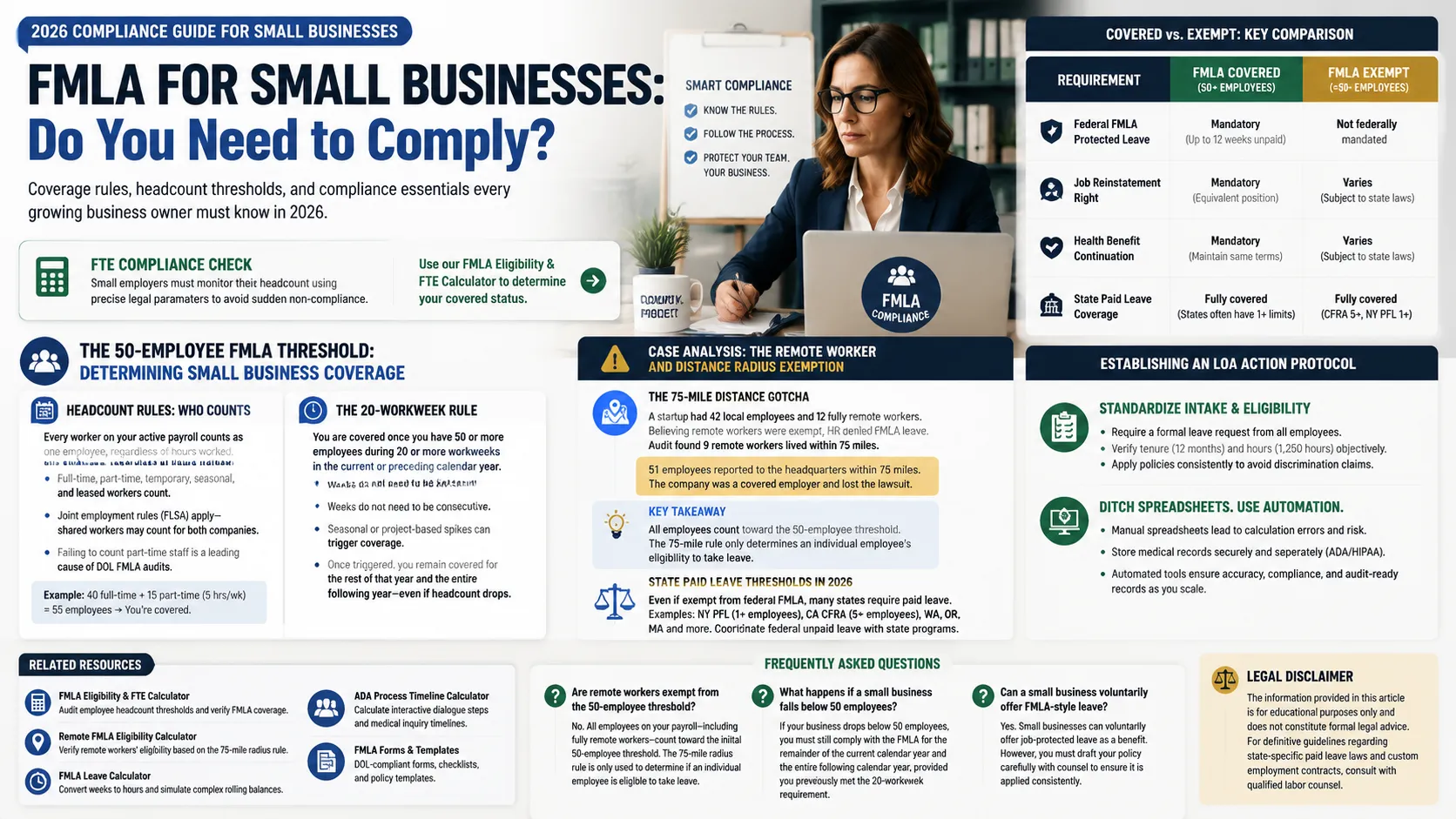
Does the FMLA apply to your business? Under federal rules, an employer is covered if they employ 50 or more workers for each working day during 20 or more calendar workweeks in the current or preceding calendar year.
Furthermore, the employee requesting leave must work at a location where the employer has 50 or more employees within a 75-mile radius. If your company has 60 remote workers scattered across 20 states, check our guide on how to calculate 75-mile radius for remote workers to confirm if they report to a qualifying HQ hub.
Step 2: Audit the 1,250-Hour Work Requirement
Even if the company is covered, the individual worker must meet two eligibility markers:
Have worked for the employer for at least 12 months (does not need to be consecutive).
Have worked at least 1,250 hours during the 12-month period immediately preceding the start of the leave.
You must audit timesheets carefully. If a part-time worker requests leave during a staffing shortage but has only logged 1,100 hours in the past year, they are not eligible for FMLA, and you are not legally required to grant FMLA leave (though state-level rules or ADA accommodations may still apply).
Step 3: Leverage the 15-Day Medical Certification Loop
You have the right to verify that the leave is for a legitimate qualifying reason. Upon receiving the FMLA request, issue the WH-308 Form and require a completed medical certification.
The employee must return the completed form within 15 calendar days.
If they return an incomplete form, you must issue a written notice specifying the deficiencies and allow 7 calendar days to cure the paperwork.
If the employee fails to return the certification without a reasonable explanation, you can deny the FMLA protection until the paperwork is submitted.
Transitioning from Manual Spreadsheets to Structured Workflows
Managing leaves manually on spreadsheets during staff shortages is incredibly risky. If a manager accidentally counts hours incorrectly or fails to track the 15-day certification deadline, your company is exposed to FMLA interference claims.
Using a structured FMLA workflow dashboard eliminates the risk of compliance errors. AI SoloHR automatically calculates employee eligibility, tracks rolling-backward hours, monitors certification windows, and provides step-by-step guidance to ensure HR department of one teams stay compliant even under tight operational pressures.
Frequently Asked Questions
Can an employer fire you while on approved FMLA?
Yes, but the termination must be completely unrelated to the FMLA leave. For example, if your company is executing a pre-planned layoff that affects an entire department, or if there is documented evidence of misconduct prior to the leave, the employee can be terminated. However, the burden of proof is heavily on the employer to prove the termination was not retaliatory.
What if my absence causes 'grievous economic injury' to the company?
The "grievous economic injury" standard only applies to the job restoration of a defined "Key Employee" (salaried, highest-paid 10 percent). It cannot be used to block the taking of FMLA leave itself. The employer must still grant the 12 weeks of leave.
Can a manager contact an employee's doctor directly to verify a note?
Under FMLA regulations, HR professionals or leave administrators may contact the employee's health care provider only for clarification or authentication of the medical certification form. However, the employee’s direct manager or supervisor is strictly prohibited from contacting the physician to prevent harassment or retaliation claims.
Legal Disclaimer
This article is for educational and informational purposes only and does not constitute formal legal advice. HR professionals and business owners should consult with a qualified employment attorney to evaluate specific FMLA compliance scenarios in 2026.